Posts

Showing posts with the label curiosity machine

Propeller Powered Balloon Helicopters - New and Improved Formula!
Image
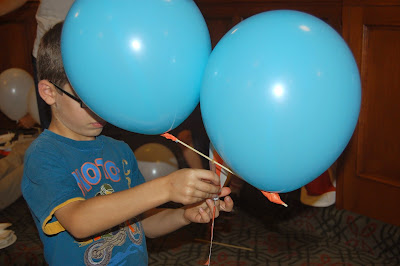
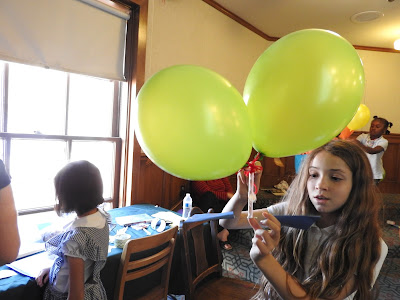
Last week kids came to Pasadena Library to learn about elastic energy and the Law of Conservation of Energy , and then build a helicopter that would rise up in the air at least briefly before coming down. We attached helium balloons to a homemade helicopter that runs on the elastic energy of a twisted-up rubber band, and since the apparatus itself is heavy enough, the whole thing generally floats gently down. (OK, some kids did have to add a weight in order to counteract the extreme lift of the helium.) Kids had a blast making their helicopters, even though it was not an easy project, and required a lot of tinkering and troubleshooting! I did this program before at Pasadena Public Library, and shared it on my blog a few years ago . I'm sharing this year's experience because I think I learned some things that might have improved the project back then. I first found the project in 2014 on curiositymachine.org . You may have to subscribe to get access to all their projec...
Building a Balanced Dinosaur

Image
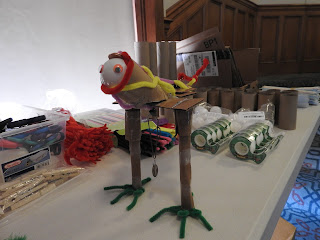
On Thursday, August 25th, while the rest of the library was closed early, kids and their parents were hanging out here in the children's Story Room learning about paleontology and center of gravity, and building their own dinosaurs! I showed a slide show about how scientists' concepts of dinosaurs has changed over the years, particularly when we think about how a dinosaur would have stood or walked. Based on scientists' knowledge of anatomy and the weight of dinosaur bones, they've come to the conclusion that most dinosaurs had tails that stuck straight out, and provided balance while holding their heads and upper bodies in a forward (not upright!) position. Curiosity Machine: Build a Balanced Dinosaur from AnnMarie Ppl Then we took a wide variety of materials, including toilet paper tubes, cardboard, tape, plastic straws, pipe cleaners, and a few colorful and fun materials like feathers and googly eyes, and made dinosaurs that stood at least 6" ta...

Curiosity Machine: Magnet Structures

Image
  Everybody knows magnets are FUN, but did you know scientists use magnets when making certain kinds of polymers?  Did you know that magnets can help chemists to sort out the tangled mess of molecules that most polymers consist of? Today's Curiosity Machine class focused on Making a Self-Assembling Structure using magnets, but the class wasn't just about magnets. One kind of self-assembling structure is a polymer, a long chain of repeating molecules that bind to create one super-strong molecule. We learned about polymers and a bit about atomic structure, then we turned our attention to magnets and to making our own structures that would link together using magnetic force. First, watch this video to get the highlights of our class: Here are my slides with recommended books for further reading: Curiosity Machine: Magnet Structures! from AnnMarie Ppl Here are some of those books: We had the table set up with dice of all kinds, pencils, paper, tape disp...

Propeller Powered Balloon Helicopters

Image
For today's Curiosity Machine classes, our last meeting of the four-week session, we did an exciting project from the Curiosity Machine website: balloon helicopters ! We learned about different kinds of energy, particularly elastic potential energy. Elastic potential energy is the potential energy stored when you bend, stretch or deform an object, and that energy converts to kinetic energy as the object bounces back. Here's a great website that explains it pretty well: Physics 20 Project . We discussed examples of elastic potential energy using a Family Feud presentation I made on Scratch. You can click on the image below to see the project, though it's supposed to be used as a tool for discussion: The project itself was challenging and I'm glad I worked on my sample ahead of time. But it's so exciting to see those balloons fly! First, you have to cut a boba straw to about the same length as the rubber band you plan to use (when it's at equilibriu...