Posts

Showing posts with the label physics

Roller Coaster Ski Jumps

Image
I'm trying to catch up on my blogging... Back in summer, as part of our STEAM 2018 year of STEAM programming, we did a fun engineering project making roller coaster ski jumps out of pipe insulators for marbles to "ski" down! I've been meaning to share the photos and videos and finally had time today. Here are the supplies I got: Pipe insulators Marbles Masking Tape I had to cut the pipe insulators in half, and did that from home. So you also need a strong knife, like for cutting meat but maybe sturdier than that. Then you have the kids get in groups of 3 or 4 and give each group of kids some insulator tubes and tape and some props and have them go to town! Each group will need a large space to work in, and one pitfall was kids trying to build their roller coasters around the other groups. That got hard sometimes, and they're kids, so they had difficulty navigating that in a polite way sometimes. I really wish I had provided more simple pr...
Propeller Powered Balloon Helicopters - New and Improved Formula!

Image
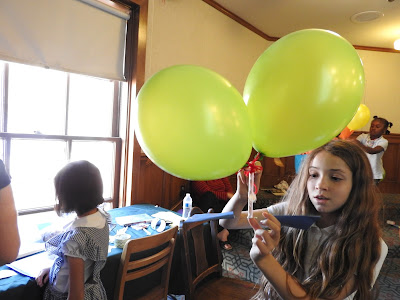
Last week kids came to Pasadena Library to learn about elastic energy and the Law of Conservation of Energy , and then build a helicopter that would rise up in the air at least briefly before coming down. We attached helium balloons to a homemade helicopter that runs on the elastic energy of a twisted-up rubber band, and since the apparatus itself is heavy enough, the whole thing generally floats gently down. (OK, some kids did have to add a weight in order to counteract the extreme lift of the helium.) Kids had a blast making their helicopters, even though it was not an easy project, and required a lot of tinkering and troubleshooting! I did this program before at Pasadena Public Library, and shared it on my blog a few years ago . I'm sharing this year's experience because I think I learned some things that might have improved the project back then. I first found the project in 2014 on curiositymachine.org . You may have to subscribe to get access to all their projec...

Light Bender

Image
On Nov. 18, 2016, to celebrate Young Readers League and its 2016 selection of Circus Mirandus by Cassie Beasley, we had a science program called "Be a Light Bender!" We had a jam-packed hour of activities exploring the physics of light and color. We did demonstrations of various phenomena, like the phosphors in a highlighter pen's ink getting excited by the ultraviolet light from a black light, and a demonstration of why the sunset looks red (the light has to travel farther through the atmosphere). We experimented with color filters and then used our knowledge to create secret messages for others to decode. We used CD spectroscopes to analyze various different light bulbs. We examined the way shadows change color when you shine colored lights on an object. The resource I used the most for this program was Exploratorium's "Science Snacks" on the website http://exploratorium.edu/snacks . It's a great site! Tons of experiments and activities with...

Building a Balanced Dinosaur

Image
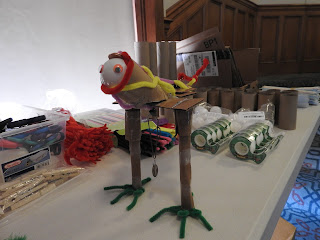
On Thursday, August 25th, while the rest of the library was closed early, kids and their parents were hanging out here in the children's Story Room learning about paleontology and center of gravity, and building their own dinosaurs! I showed a slide show about how scientists' concepts of dinosaurs has changed over the years, particularly when we think about how a dinosaur would have stood or walked. Based on scientists' knowledge of anatomy and the weight of dinosaur bones, they've come to the conclusion that most dinosaurs had tails that stuck straight out, and provided balance while holding their heads and upper bodies in a forward (not upright!) position. Curiosity Machine: Build a Balanced Dinosaur from AnnMarie Ppl Then we took a wide variety of materials, including toilet paper tubes, cardboard, tape, plastic straws, pipe cleaners, and a few colorful and fun materials like feathers and googly eyes, and made dinosaurs that stood at least 6" ta...

Curiosity Machine: Magnet Structures

Image
  Everybody knows magnets are FUN, but did you know scientists use magnets when making certain kinds of polymers?  Did you know that magnets can help chemists to sort out the tangled mess of molecules that most polymers consist of? Today's Curiosity Machine class focused on Making a Self-Assembling Structure using magnets, but the class wasn't just about magnets. One kind of self-assembling structure is a polymer, a long chain of repeating molecules that bind to create one super-strong molecule. We learned about polymers and a bit about atomic structure, then we turned our attention to magnets and to making our own structures that would link together using magnetic force. First, watch this video to get the highlights of our class: Here are my slides with recommended books for further reading: Curiosity Machine: Magnet Structures! from AnnMarie Ppl Here are some of those books: We had the table set up with dice of all kinds, pencils, paper, tape disp...

Scratch for Experienced Users: Flappy Bat

Image
Today we made videogames using Scratch, based on the infamous "Flappy Bird" videogame that brought its creators notoriety and established them in the halls of memorable bad game design forever :) We followed a tutorial I created and chose new sprites for our flappy character--many kids chose airplanes, fish, or other animals, and a few chose bats. The end code looks something like this (this is just the code for the bat that flies through the pipes): The final product is supposed to work like this (click on the picture and you'll be taken to the game which you can play): If you'd like to see the kids' projects they are posted here: Pasadena Library Kids' Blog The kids did a great job. Even one child who was not really very experienced with Scratch turned out to be quite sharp and able to follow all the difficult instructions. Despite having a lot of technical difficulties, almost everyone was able to go home with a finished game emailed to the...