Posts

Some videos of STEAM programs we've had lately at Central Library

Image
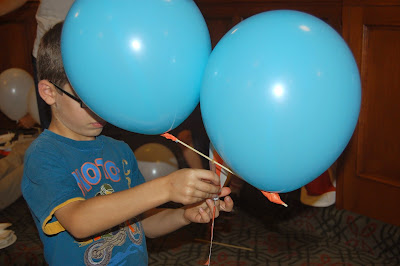
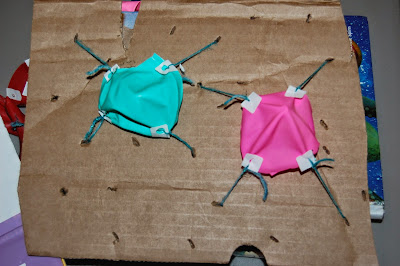
We recently had a few STEAM-related programs at the library that I wanted to share on here. The first was called "Tablets and Tech for Kids," and we were using the library's iPads and robots to learn coding, as well as using the library's iPads and Osmo game systems to complete physics and geometry challenges. Then we had another program about making musical instruments, which encouraged kids to try to experiment and find ways to design their instruments to play better. Kids and parents struggled to make great drums with very taut balloon membranes. Children also tried to make their rubber-band guitar strings more taut, and played with different kinds of rubber bands to get the design they wanted.

The Science Behind Making Music

Image
This afternoon we had a program at Pasadena Library about how to make a musical instrument--something that would produce not just noise, but definite pitches that you could change or manipulate.  We learned about aerophones, chordophones, idiophones and membranophones, and then got a chance to make our own DIY instruments. Here was my setup: Not shown: a large container of water, which we needed for some of the instruments. First, we talked about the properties of sound and experimented with a "head harp," which is made by putting a string through a wire hanger and holding both ends up to your ears to hear what sounds it made when we let the hanger hit the wall.  Without the strings being close to your ears, all you hear is a faint click, but when the strings are held up to your ears it sounds like a gong or a church bell.  This helped to convey a lesson about how much faster and better sound moves through solids than through air. After some mo...

Great books about space and the planets

Image
I was doing some work on the nonfiction collection today, focusing on the shelves about astronomy, space, planets and time. While examining the books closely, I came across a few that I want to remember as being really interesting: Faraway Worlds: Planets Beyond Our Solar System , by Paul Halpern and Illustrated by Lynette R. Cook, is a fascinating look at the search for distant planets. It contains simple visual demonstrations of how scientists are able to find stars that have planets--the "wobbling star" is explained with a good diagram about the gravitational pull of a large planet. Halpern's writing is very accessible and Cook's illustrations take the book to another level of imaginative wonder, as she artfully speculates what a beach might look like on a planet with two suns. There is even a page at the end dedicated to explaining how Cook comes up with her illustrations. Really a fantastic and imaginative read. I found a lot of books about the Hubble ...

Make a flute with a turkey baster!

Image
This is from the book Howtoons: Tools of Mass Construction by Saul Griffith, published by Image Comics. It tells you how you can make a flute from a turkey baster, just by filling the baster halfway with water and then squeezing the baster so that the water rises and makes different pitches. It's similar to many other ideas involving wine glasses and other things, but I just had never heard of using a baster before! And what's nice about the baster is you can actually manipulate it like an instrument. Different water levels will resonate at different frequencies. Maybe I'll do this with my library for my Science of Music program this summer!

Propeller Powered Balloon Helicopters

Image
For today's Curiosity Machine classes, our last meeting of the four-week session, we did an exciting project from the Curiosity Machine website: balloon helicopters ! We learned about different kinds of energy, particularly elastic potential energy. Elastic potential energy is the potential energy stored when you bend, stretch or deform an object, and that energy converts to kinetic energy as the object bounces back. Here's a great website that explains it pretty well: Physics 20 Project . We discussed examples of elastic potential energy using a Family Feud presentation I made on Scratch. You can click on the image below to see the project, though it's supposed to be used as a tool for discussion: The project itself was challenging and I'm glad I worked on my sample ahead of time. But it's so exciting to see those balloons fly! First, you have to cut a boba straw to about the same length as the rubber band you plan to use (when it's at equilibriu...

Octopus Chromatophores

Image
Today we learned about color changing animals and how they're able to expand or contract special pigment sacs called chromatophores in their skin, in order to give the overall visual effect of having changed color. In reality, they have just chosen which pigments to expand and which ones to shrink, but all the pigments are there! We talked about how octopuses do this and how they also have papillae in their skin that can change the texture of their skin from smooth to rough or bumpy, which gives them an added camouflage benefit. To demonstrate how this works, I programmed a simulation of chromatophores expanding and contracting to match their environment using Scratch. You just click on the words Brown, Red, or Yellow to make the background change, and watch as the chromatophores change by expanding or contracting to emphasize that color! Click on the picture to go to the Scratch website and play with this simulation. Our hands on project today was pretty easy--to build a ...

Wind Pumps

Image
Today's project was designing a wind-powered water pump! We discussed the history of harnessing the wind to power machines, from Hero of Alexandria's wind-powered pipe organ in the 1st century A.D. to the wind pumps used in Muslim cultures in the Middle East and Central Asia, to the windmills created by the Dutch (which--I didn't know before--could mill grain AND pump water from the ground!). The book I mentioned in our discussion today was called Wind Power , written by Ian Graham and published by Raintree Steck-Vaughn Publishers. We talked about Daniel Halladay, the American inventor of the wind pumps used in farms across America. We talked about the Law of Conservation of Energy, how energy is never created or destroyed, but only changes form--in this case, changing from kinetic energy to mechanical energy, and in wind turbines that power homes, it is also converted to electrical energy. We talked about converting different kinds of motion using a mach...