Posts

Scratch Cards for Teaching Basic Animation

Image
Right now we're doing a four-week class on making animations with Scratch. Last week, we introduced the kids to the Scratch interface and some of the key blocks they would need. They animated a simple sprite that had multiple costumes already built. One of the challenges of doing a program like Scratch coding is that if you have the kids code a predetermined project step by step, they may learn more tools but they don't have as much opportunity to think critically or creatively. I used to teach Scratch with tutorials where I told the kids, step by step, how to build the code. Now I don't do that as much anymore. Instead, I want the kids to follow a set of instructions but figure out the blocks to use on their own. Kids like individuality. They don't want their project to come out looking exactly like everyone else's. They want options. So I created some cards, inspired by the Scratch Cards on ScratchEd . I gave each kid a challenge, like "Make a Bat Fl...

Archaeology Program: Dig for Ancient Treasures

Image
Recently one of my colleagues in the Youth Services department, Marie Plug, and one of our pages from Support Services, Luz Mejia-Ramos, put together an amazing science program for kids--an archaeological dig! I'm sharing Marie's blog post about it and reprinting it with her permission. It was such a cool program, giving kids a chance to dig in sand to find "artifacts" like broken pieces of a clay pot, bones from a replica human skeleton, and a replica of a papyrus from Ancient Egypt. But without further ado, I'll let Marie tell you more... Dig for Ancient Treasures: Archaeology By Marie Plug Twenty seven budding archaeologists participated in Pasadena Central Library's first archaeological dig. Fortunately for them our Library has a "resident" archaeologist on staff - Luz Mejia-Ramos. Luz works for the Support Services Department at Central Library but during her time off she travels the world to participate in archaeological digs. Luz ob...

Coding with Ozobots

Image
Have you considered doing a class with Ozobots, but weren't sure where to begin? You can do an Hour of Code activity with Ozoblockly, starting out with a Square Walk and working up to a robot dance competition. But be sure to have a backup plan in case calibration fails. Check out the Pasadena Public Library Kids Blog and our latest post on our experiences with Ozobots...and the importance of having a Plan B!! http://pasadena-library.net/kids/2018/coding-with-ozobots-kids-coding-club/

Propeller Powered Balloon Helicopters - New and Improved Formula!

Image
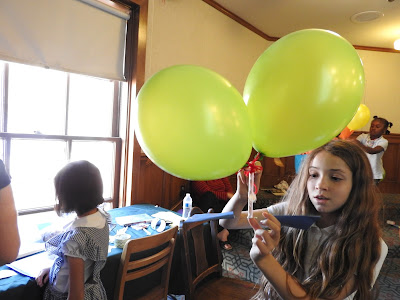
Last week kids came to Pasadena Library to learn about elastic energy and the Law of Conservation of Energy , and then build a helicopter that would rise up in the air at least briefly before coming down. We attached helium balloons to a homemade helicopter that runs on the elastic energy of a twisted-up rubber band, and since the apparatus itself is heavy enough, the whole thing generally floats gently down. (OK, some kids did have to add a weight in order to counteract the extreme lift of the helium.) Kids had a blast making their helicopters, even though it was not an easy project, and required a lot of tinkering and troubleshooting! I did this program before at Pasadena Public Library, and shared it on my blog a few years ago . I'm sharing this year's experience because I think I learned some things that might have improved the project back then. I first found the project in 2014 on curiositymachine.org . You may have to subscribe to get access to all their projec...

STEAM Team: Make Your Own Electric Quiz!

Image
Last week I visited the Hastings Branch of Pasadena Public Library to present a program to their "STEAM Team," a monthly club they have for kids 9-12 years old. We did a program about electricity called "Make Your Own Electric Quiz." It was so much fun exploring the mathematical principles involved in electrical circuits, such as the inverse ratio relationship between voltage, resistance and current explored by Georg Ohm in the early 19th century. I LOVE anything to do with scientific laws, and we got deep into Ohm's law (I = V/R). Then kids wrote down math questions and answers on post-it notes, placing the post-its next to some brass paper fasteners I had prepped for them on a sheet of cardstock. On the other side, they wound a copper wire from the brass fastener for each question to the brass fastener for its correct answer. To reinforce the things we learned about Ohm's law, I deliberately used a battery source not intended for 5mm LED diodes--...