Posts

Showing posts with the label rubber bands

Propeller Powered Balloon Helicopters - New and Improved Formula!
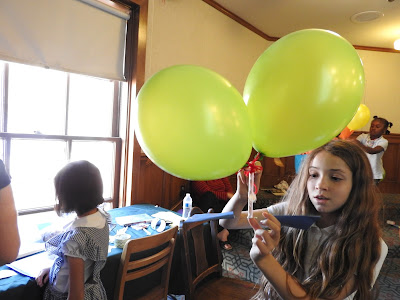
Image
Last week kids came to Pasadena Library to learn about elastic energy and the Law of Conservation of Energy , and then build a helicopter that would rise up in the air at least briefly before coming down. We attached helium balloons to a homemade helicopter that runs on the elastic energy of a twisted-up rubber band, and since the apparatus itself is heavy enough, the whole thing generally floats gently down. (OK, some kids did have to add a weight in order to counteract the extreme lift of the helium.) Kids had a blast making their helicopters, even though it was not an easy project, and required a lot of tinkering and troubleshooting! I did this program before at Pasadena Public Library, and shared it on my blog a few years ago . I'm sharing this year's experience because I think I learned some things that might have improved the project back then. I first found the project in 2014 on curiositymachine.org . You may have to subscribe to get access to all their projec...

Some videos of STEAM programs we've had lately at Central Library

Image
We recently had a few STEAM-related programs at the library that I wanted to share on here. The first was called "Tablets and Tech for Kids," and we were using the library's iPads and robots to learn coding, as well as using the library's iPads and Osmo game systems to complete physics and geometry challenges. Then we had another program about making musical instruments, which encouraged kids to try to experiment and find ways to design their instruments to play better. Kids and parents struggled to make great drums with very taut balloon membranes. Children also tried to make their rubber-band guitar strings more taut, and played with different kinds of rubber bands to get the design they wanted.

The Science Behind Making Music

Image
This afternoon we had a program at Pasadena Library about how to make a musical instrument--something that would produce not just noise, but definite pitches that you could change or manipulate.  We learned about aerophones, chordophones, idiophones and membranophones, and then got a chance to make our own DIY instruments. Here was my setup: Not shown: a large container of water, which we needed for some of the instruments. First, we talked about the properties of sound and experimented with a "head harp," which is made by putting a string through a wire hanger and holding both ends up to your ears to hear what sounds it made when we let the hanger hit the wall.  Without the strings being close to your ears, all you hear is a faint click, but when the strings are held up to your ears it sounds like a gong or a church bell.  This helped to convey a lesson about how much faster and better sound moves through solids than through air. After some mo...