Posts

Showing posts with the label books

Exploring the Night Sky: Astronomy Festival for All Ages

Image
On Thursday, February 27, we had a special astronomy festival for the whole family! People of all ages got to learn something new and inspiring about the way our understanding of the universe has grown, and also the ways that you can help scientists track changes in night sky visibility. Globe At Night Neighborhood Science Kit When Los Angeles Public Library got a grant for bringing Neighborhood Science to other libraries, Pasadena was chosen as one of the first libraries to get their Neighborhood Science kits. There are currently five Neighborhood Science kits  at Pasadena that you can check out and use to conduct observations and collect data that will help scientists understand more about the way our climate is changing, our air and water quality is changing, etc. The Globe At Night kit  includes a Sky Quality Meter for measuring the darkness in your area, and other tools and information. You can use a Sky Quality Meter to get a reading of the sky's level of darkness, ...
George Washington Carver for Kids by Peggy Thomas: a book review

Image
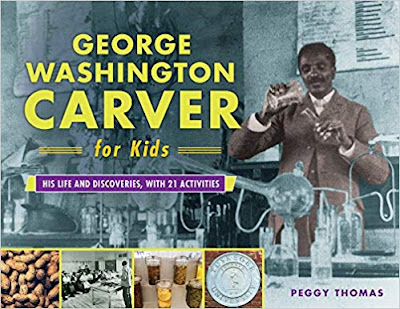
What rock have I been living under, that I had no idea George Washington Carver , the scientist whose name is forever linked in my mind with peanuts, was also an accomplished  painter ? That he loved music and paid for piano and voice lessons with his paintings? Talk about putting the "A" in STEAM! He, in fact, had so many interests that one of his friends commented: "Whoever heard of any one person doing half so many things?"   Who, indeed! And that isn't all. I didn't know he built his own sod house on the frontier. I didn't know much about his many, many experiences of racism. I didn't know that he pulled himself up from nothing to put himself through college with unbelievable drive and sheer will, living in horrible, subhuman conditions, scrubbing clothes to pay his tuition. And despite all his hardships, he still comes across as just the most pleasant, inspiring, hardworking, and mindblowingly talented person you could ever me...

Building a Balanced Dinosaur

Image
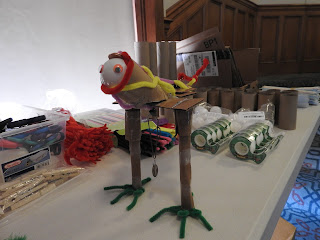
On Thursday, August 25th, while the rest of the library was closed early, kids and their parents were hanging out here in the children's Story Room learning about paleontology and center of gravity, and building their own dinosaurs! I showed a slide show about how scientists' concepts of dinosaurs has changed over the years, particularly when we think about how a dinosaur would have stood or walked. Based on scientists' knowledge of anatomy and the weight of dinosaur bones, they've come to the conclusion that most dinosaurs had tails that stuck straight out, and provided balance while holding their heads and upper bodies in a forward (not upright!) position. Curiosity Machine: Build a Balanced Dinosaur from AnnMarie Ppl Then we took a wide variety of materials, including toilet paper tubes, cardboard, tape, plastic straws, pipe cleaners, and a few colorful and fun materials like feathers and googly eyes, and made dinosaurs that stood at least 6" ta...

Great books about space and the planets

Image
I was doing some work on the nonfiction collection today, focusing on the shelves about astronomy, space, planets and time. While examining the books closely, I came across a few that I want to remember as being really interesting: Faraway Worlds: Planets Beyond Our Solar System , by Paul Halpern and Illustrated by Lynette R. Cook, is a fascinating look at the search for distant planets. It contains simple visual demonstrations of how scientists are able to find stars that have planets--the "wobbling star" is explained with a good diagram about the gravitational pull of a large planet. Halpern's writing is very accessible and Cook's illustrations take the book to another level of imaginative wonder, as she artfully speculates what a beach might look like on a planet with two suns. There is even a page at the end dedicated to explaining how Cook comes up with her illustrations. Really a fantastic and imaginative read. I found a lot of books about the Hubble ...

Make a flute with a turkey baster!

Image
This is from the book Howtoons: Tools of Mass Construction by Saul Griffith, published by Image Comics. It tells you how you can make a flute from a turkey baster, just by filling the baster halfway with water and then squeezing the baster so that the water rises and makes different pitches. It's similar to many other ideas involving wine glasses and other things, but I just had never heard of using a baster before! And what's nice about the baster is you can actually manipulate it like an instrument. Different water levels will resonate at different frequencies. Maybe I'll do this with my library for my Science of Music program this summer!

Suspension Bridges

Image
We've started up Curiosity Machine again! For yesterday's Curiosity Machine classes, we built suspension bridges! This is one of the civil engineering challenges on Curiositymachine.org . First we learned how spiders build their webs: https://www.youtube.com/watch?v=9qaaYlpVmJM This picture from p. 21 of Do All Spiders Spin Webs? by Melvin and Gilda Berger, Illustrated by Roberto Osti and published by Scholastic illustrates the process of a spider web very well: Then we learned about the basics of suspension bridge design, how the cables help a bridge to hold firm and strong and balance out all the forces acting on it in all directions. I showed the kids this page from the book Bridges! Amazing Structures to Design, Build & Test by Carol A. Johmann and Elizabeth J. Rieth, published by Williamson Publishing: We learned about John Roebling, the great engineer behind the Brooklyn Bridge, and how he also strengthened the Niagra Bridge with more trusses and ...

Cube Bubbles

Image
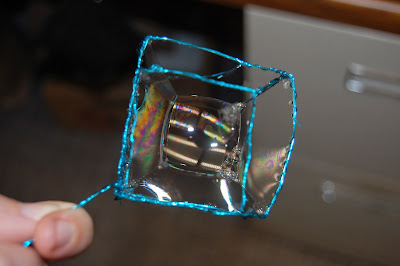
I've been doing science activities in the public library for the last couple of years but realized today that it's time I started sharing them with the wider world! I'm thinking what I'll do is post what I learn or what projects I can make from books. I may not post every day or every week, just when I have something worth posting. Today's picture worth posting is of a cube bubble blower I made after reading about it in this book: Truly a wonderful book every library should own! After reading that you could do this, I simply had to try it myself. And then I had to share it with the kids in my Curiosity Machine class! First the bubble makes a square shape inside, but if you can manage to catch another bubble in it as you put it back into your bubble mixture, the result is a cube! Try it at home! I used craft wire to make mine. You could try making different kinds of prismatic bubble holders (pyramids, dodecahedron or other polyhedrons) and see...