Posts

Showing posts with the label crafts

STEAM Themed Crafts for Preschool Storytimes
Image
Right now my library is working on a STEAM grant that we got for 2018, and one of my tasks to help the team is to gather up ideas for STEAM elements to be added to our rotating storyboxes. Storyboxes are bins that get sent weekly from one library branch to another, sharing books, DVDs, CDs, flannelboard sets, song lyrics and craft ideas around a theme. Librarians and techs use the materials in the boxes to put together their storytimes for the week. For 2018, we want our storyboxes to reflect our library's STEAM emphasis. So I'm working on finding ideas that librarians and tech specialists can use when putting their bins together. Here's what I've got so far: Seasons, Trees: Make Four Season Trees! https://www.education.com/activity/article/Make_Four_Season_Trees/ Sound: Paper cup string phone https://www.scientificamerican.com/article/talk-through-a-string-telephone-bring-science-home/ Nutrition: Healthy Food Hunt and Paper Plate Collage https://www.educati...

Make a Wind Generator

Image
On May 19, 2017, kids came to the Pasadena Public Library to make wind turbines that would generate electricity by turning the shaft of a hobby motor. We were inspired by a project we found at https://www.exploratorium.edu/snacks/light-wind . The goal was to use the motors in reverse--instead of the electricity making the shaft turn, the turning would make electricity! We hoped to produce enough energy to light an LED bulb attached to the motor. It didn't work out that way, but we still made a great science lesson of it. I provided several different motors, but every time I tested them myself, I could not get the LED light bulb to come on. One kind of motor I got at Fry's was just too strong to turn in the wind. It probably would have needed blades several feet long and a floor fan wasn't going to produce enough wind. The other kind turned easily , but didn't generate quite enough voltage. (One of the kids accurately noted: "Don't you need more energy to op...

Building a Balanced Dinosaur

Image
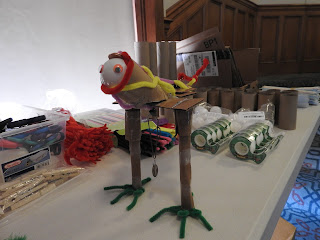
On Thursday, August 25th, while the rest of the library was closed early, kids and their parents were hanging out here in the children's Story Room learning about paleontology and center of gravity, and building their own dinosaurs! I showed a slide show about how scientists' concepts of dinosaurs has changed over the years, particularly when we think about how a dinosaur would have stood or walked. Based on scientists' knowledge of anatomy and the weight of dinosaur bones, they've come to the conclusion that most dinosaurs had tails that stuck straight out, and provided balance while holding their heads and upper bodies in a forward (not upright!) position. Curiosity Machine: Build a Balanced Dinosaur from AnnMarie Ppl Then we took a wide variety of materials, including toilet paper tubes, cardboard, tape, plastic straws, pipe cleaners, and a few colorful and fun materials like feathers and googly eyes, and made dinosaurs that stood at least 6" ta...

Playing a Record Without a Turntable

Image
Monday's hands-on science program, "The Science Behind Recording Music," challenged tweens to come up with several iterations of a gramophone that could play the sound stored on a vinyl record with only their hands to power it. First, tweens learned about the history of sound recording and its great inventors, from Leon Scott to Alexander Graham Bell, to Edison to Berliner. I engaged the kids in some fun questions to test their critical thinking skills, like: "How many grooves are on each side of a record?" and "How many times a second would a record turn if it's turning at 33 1/3 revolutions per minute?" Here are my slides from that presentation: Science of Recorded Music from AnnMarie Ppl And here is the video I created to give them a sample of what they would be doing: Then we started spinning records of our own. We made a gramophone out of a tin can, aluminum foil, and a pin, and lowered the pointy end of the pin onto the...

Some videos of STEAM programs we've had lately at Central Library

Image
We recently had a few STEAM-related programs at the library that I wanted to share on here. The first was called "Tablets and Tech for Kids," and we were using the library's iPads and robots to learn coding, as well as using the library's iPads and Osmo game systems to complete physics and geometry challenges. Then we had another program about making musical instruments, which encouraged kids to try to experiment and find ways to design their instruments to play better. Kids and parents struggled to make great drums with very taut balloon membranes. Children also tried to make their rubber-band guitar strings more taut, and played with different kinds of rubber bands to get the design they wanted.

The Science Behind Making Music

Image
This afternoon we had a program at Pasadena Library about how to make a musical instrument--something that would produce not just noise, but definite pitches that you could change or manipulate.  We learned about aerophones, chordophones, idiophones and membranophones, and then got a chance to make our own DIY instruments. Here was my setup: Not shown: a large container of water, which we needed for some of the instruments. First, we talked about the properties of sound and experimented with a "head harp," which is made by putting a string through a wire hanger and holding both ends up to your ears to hear what sounds it made when we let the hanger hit the wall.  Without the strings being close to your ears, all you hear is a faint click, but when the strings are held up to your ears it sounds like a gong or a church bell.  This helped to convey a lesson about how much faster and better sound moves through solids than through air. After some mo...

Make a flute with a turkey baster!

Image
This is from the book Howtoons: Tools of Mass Construction by Saul Griffith, published by Image Comics. It tells you how you can make a flute from a turkey baster, just by filling the baster halfway with water and then squeezing the baster so that the water rises and makes different pitches. It's similar to many other ideas involving wine glasses and other things, but I just had never heard of using a baster before! And what's nice about the baster is you can actually manipulate it like an instrument. Different water levels will resonate at different frequencies. Maybe I'll do this with my library for my Science of Music program this summer!

Curiosity Machine: Hands-on Science at the Pasadena Public Library

Image
This summer I tried a new science workshop at the Pasadena Central Library, for tweens ages 9 and up, using the website http://www.curiositymachine.org . This is a great website for librarians, teachers and homeschooling parents, with its collection of projects, how-to videos, and opportunities for children to interact with scientists and get feedback on their projects. Free science classes are definitely in high demand, and even after I split it up into two classes the spots filled up right away! We started each class learning about some science concept and then applying what we learned to a hands-on challenge. We learned about Newton’s laws of motion, tessellations, the aerodynamics of bird flight, and simple machines. We: Shot stomp rockets, Made bird wings that could be flapped hard enough to rotate us around in an office chair, Engineered honeycomb structures strong enough to hold a stack of dictionaries, And designed sharp levers for picking up and breaking e...

Bat Signals

Image
I'm doing a craft project for Batman's 75th Anniversary where the kids are going to make Bat Signals out of Pringles cans. I had two different kinds of Pringles cans: a short one and a long one. I wanted to see, which can produced a clearer bat signal when an LED keychain flashlight was placed inside? Well, the first thing I had to do was construct a "stand" for the flashlight so that it would shine directly upwards. It kept falling down, ruining the effect! I cut out two circles (using the Pringles lid as a guide) of cardstock, glued them together so that they would be sturdy, and folded them into a semicircle shape. With the fold I cut some slits going outward in a kind of star formation so that the flashlight could poke through. Then I taped all around and underneath. Finally, I cut a few more slits around the outer circumference of my circle and bent the sides down like a hexagon to make it into a "stand." Worked quite well and I don't fors...

Cube Bubbles

Image
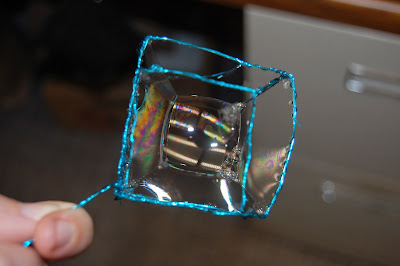
I've been doing science activities in the public library for the last couple of years but realized today that it's time I started sharing them with the wider world! I'm thinking what I'll do is post what I learn or what projects I can make from books. I may not post every day or every week, just when I have something worth posting. Today's picture worth posting is of a cube bubble blower I made after reading about it in this book: Truly a wonderful book every library should own! After reading that you could do this, I simply had to try it myself. And then I had to share it with the kids in my Curiosity Machine class! First the bubble makes a square shape inside, but if you can manage to catch another bubble in it as you put it back into your bubble mixture, the result is a cube! Try it at home! I used craft wire to make mine. You could try making different kinds of prismatic bubble holders (pyramids, dodecahedron or other polyhedrons) and see...